

Last updated: August 10, 2026
A rotating shift work sleep schedule constantly alters work hours, which can disrupt the body’s internal clock, or circadian rhythm. This desynchronization often leads to shorter sleep duration, inconsistent sleep timing, and feelings of fatigue. Research shows that the primary challenge is the lack of a stable routine, making it difficult for the body to anticipate periods of rest and activity.
Key Takeaways
- What It Is: Rotating shift work involves schedules that change over time, cycling between day, evening, and night shifts, unlike a fixed or permanent night shift.
- The Core Challenge: The main issue is the conflict with the body’s natural 24-hour circadian rhythm, which regulates the sleep-wake cycle. Constantly changing shifts prevents this internal clock from adapting.
- Impact on Sleep: Data often associates rotating shifts with getting less total sleep, experiencing more fragmented or lower-quality sleep, and increased daytime sleepiness.
- Rotating vs. Permanent Night Shifts: While permanent night work is also challenging, it offers a stable routine that allows for partial adaptation. Rotating shifts present a constantly moving target for the body clock.
- What Data Shows: Research measures factors like sleep duration, sleep timing, and efficiency. However, findings are based on population averages and cannot predict an individual’s experience.
- Practical Focus: Managing a rotating schedule involves prioritizing sleep hygiene, creating a dark and quiet sleep environment for daytime rest, and strategically using light exposure to help signal wakefulness to the body.
A significant portion of the modern workforce operates outside the traditional 9-to-5 schedule. In the United States alone, approximately 16% of employees work on alternative schedules, including evening shifts, night shifts, and rotating patterns [1]. For those navigating a rotating shift work sleep schedule, maintaining consistent, restorative sleep can feel like a constant battle.
This article explores what the data says about how these changing schedules affect sleep, drawing from established sleep science to provide practical, evidence-informed insights. It is intended as a general educational resource, not as a source of medical advice.
What Is a Rotating Shift Schedule?
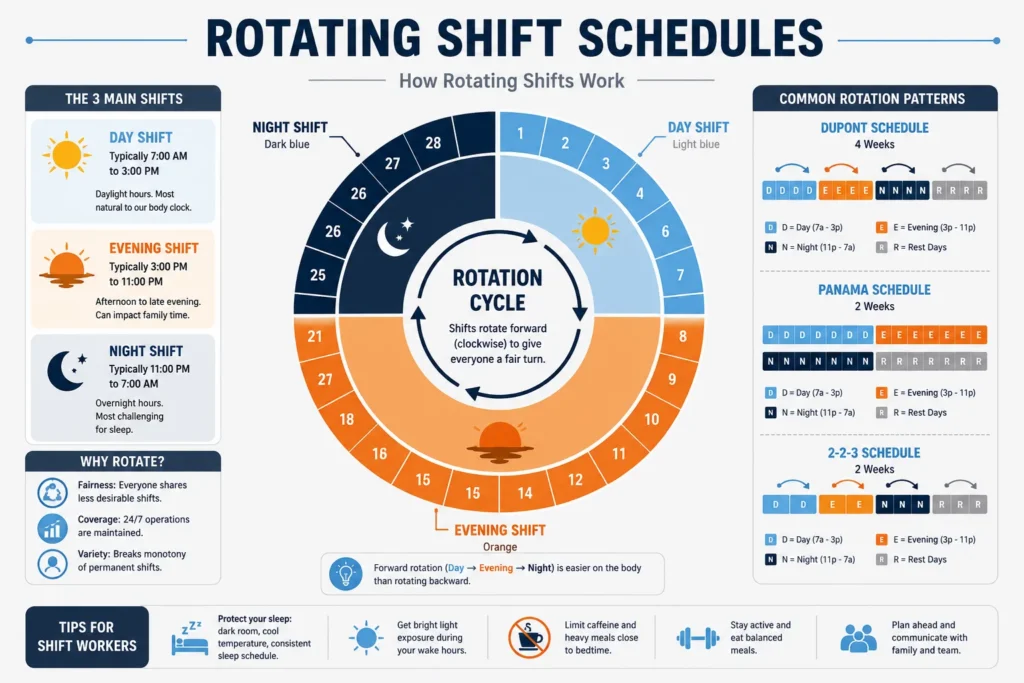
A rotating shift schedule is a work arrangement where an employee’s shift times change on a set cycle. Instead of working the same hours every day (like 9 a.m. to 5 p.m. or a permanent 11 p.m. to 7 a.m. night shift), a worker’s schedule moves between day, evening, and/or night shifts.
These rotations can vary widely. Some are slow, changing every few weeks or months. Others are fast, changing every few days. Common patterns include the “Continental” or “Panama (2-2-3)” schedules, which cycle workers through a series of day, swing, and night shifts followed by days off [1].
The key difference between rotating and permanent shifts is consistency. A permanent night nurse works the same overnight hours every shift, allowing their body to partially adjust to a stable nocturnal routine. A rotating-shift worker, however, must constantly readjust their sleep timing, which presents a unique set of challenges.
How a Rotating Shift Work Sleep Schedule Can Change Sleep Timing
Your body has an internal 24-hour clock known as the circadian rhythm. This biological pacemaker is primarily regulated by light exposure and tells your body when to feel awake and when to feel sleepy. A regular daytime schedule aligns work and social activities with the body’s natural drive for wakefulness during the day and sleep at night.
A rotating shift work sleep schedule directly conflicts with this internal clock.
When you switch from a day shift to a night shift, you are asking your body to be alert and productive when it is biologically programmed to be asleep. Conversely, you must try to sleep during the day, when your circadian rhythm is promoting wakefulness. This mismatch can lead to:
- Difficulty Falling Asleep: Trying to sleep during the daylight hours can be challenging because your body clock is sending strong alerting signals.
- Shorter Sleep Duration: Sleep during the day is often lighter, more fragmented, and shorter than night sleep. Environmental factors like sunlight, traffic noise, and family activities can easily interrupt it.
- Increased Sleepiness at Work: The body’s natural dip in alertness during the late-night hours (often between 2 a.m. and 6 a.m.) can cause profound drowsiness during a night shift.
This constant push and pull between the work schedule and the internal clock is the primary reason why night shift workers feel tired all the time.
What Research Says About Rotating Shift Work and Sleep
In industrialized nations, it’s estimated that about 20% of the workforce is engaged in some form of shift work [2]. Decades of research have explored how a rotating shift work sleep schedule affects sleep, and while findings vary by industry and schedule type, some consistent themes have emerged.
Much of the data associates rotating shift work with negative sleep outcomes compared to regular day work. These include:
- Reduced Total Sleep Time: Many studies find that rotating shift workers, particularly during their night shift blocks, sleep less than their day-working counterparts. The reduction can be one to two hours per day or more.
- Increased Sleep Disturbances: Workers on rotating schedules often report more trouble falling asleep and staying asleep.
- Circadian Misalignment: Objective measures show that the body’s internal rhythms (like core body temperature and hormone release) remain tied to a day-oriented cycle, even when the person is working at night.
It is important to understand that these are associations found in population-level data. They show a trend, but they do not mean that every single person on a rotating schedule will experience these effects to the same degree.
Why Changing Shifts Can Make Sleep Schedules Difficult to Maintain
The fundamental difficulty of a rotating shift work sleep schedule is the constant state of flux. Your body’s circadian system thrives on routine, using predictable patterns of light, meals, and activity to anchor your sleep-wake cycle. Rotating shifts remove that predictability.
Each shift change is like inducing a mild form of jet lag. Your internal clock, which can only shift by about an hour per day, cannot keep up with a rapid 8- or 12-hour jump in your schedule. Before your body has a chance to partially adapt to one schedule, it is time to change again. This can disrupt the natural buildup of what is known as sleep drive, your body’s hunger for sleep, making it harder to feel sleepy at your desired bedtime.
This persistent desynchronization is a core component of effective fatigue management. Understanding this biological conflict is the first step toward developing practical strategies to get better sleep.
Rotating Shifts vs. Permanent Night Shifts

While both rotating and permanent night shifts challenge the body’s natural rhythms, research suggests they do so in different ways. Neither is necessarily “easy,” but the nature of the challenge differs.
A permanent night worker has a consistent, albeit inverted, schedule. Over time, their circadian rhythm can partially adapt. With strict sleep hygiene, such as maintaining the same sleep-wake times even on days off and carefully managing light exposure, they can create a stable routine that supports better daytime sleep.
A worker on a rotating shift work sleep schedule faces perpetual instability. The body’s clock is never given enough time to fully adjust to one pattern before it must change again. This can be more disruptive for some individuals than settling into a fixed nocturnal schedule.
However, a permanent night schedule can lead to greater social isolation, as the worker is consistently out of sync with the rest of society. Rotating schedules, while disruptive to sleep, may offer more opportunities for social and family engagement during day-shift blocks. Ultimately, the impact depends on the specific rotation, the individual’s biology, and their lifestyle.
What Researchers Measure When Studying Shift-Work Sleep
To understand how different schedules affect rest, researchers look at several key metrics. When you see data about shift work and sleep, it is often based on these measurements.
| Factor | Rotating Shifts | Permanent Night Shifts |
|---|---|---|
| Schedule Timing | Constantly changing (e.g., days to nights) | Stable and predictable (always nights) |
| Circadian Adaptation | Very difficult; body is in a constant state of flux. | Partial adaptation is possible over time. |
| Sleep Duration | Often reduced and highly variable depending on the shift. | Can be chronically short but may be more stable day-to-day. |
| Sleep Quality | Frequently disrupted due to changing sleep times. | Can be improved with strict routine and light management. |
| Social Life | May offer more flexibility during day-shift blocks. | Can lead to chronic social disconnection. |
Researchers often use a combination of:- Sleep Diaries: Self-reported logs where individuals record their sleep times, wake times, and perceived sleep quality.
- Actigraphy: Wrist-worn devices that track movement to estimate sleep-wake patterns over days or weeks.
- Polysomnography (PSG): An in-lab sleep study that measures brain waves, eye movements, and breathing. This is the gold standard but is less common for long-term shift work studies.
Understanding these measures helps clarify what a study can and cannot tell us about the real-world experience of a rotating shift work sleep schedule.
What the Data Can, and Cannot, Tell Us
While research provides valuable insights, it is crucial to recognize its limitations. The data shows population-level trends, not individual certainties.
- Generalization: A study on nurses in a hospital may not apply to factory workers or first responders due to different job demands and environments.
- Schedule Variation: The term “rotating shift” covers hundreds of different patterns. A fast, counter-clockwise rotation (nights to evenings to days) is often considered more disruptive than a slow, clockwise rotation (days to evenings to nights).
- Individual Differences: People respond to shift work differently based on genetics, age, lifestyle, and underlying health. Some individuals are natural “night owls” and may adapt more easily than “morning larks.”
The data provides a powerful framework for understanding the biological challenges of shift work, but it is not a script for your personal experience. The goal is to use this knowledge to inform your own strategies for better sleep and recovery. Improving your sleep environment with tools like the best blackout curtains for shift workers is a practical first step.
Key Takeaways About Rotating Shift Work Sleep Schedules
Managing sleep on a rotating schedule is an ongoing process of strategy and adaptation. The research points toward several key principles that can help you thrive.
- Prioritize a Consistent Anchor Sleep: On your days off, try to maintain a relatively consistent wake-up time. This can help “anchor” your circadian rhythm and prevent it from drifting too much.
- Control Your Light Exposure: Light is the most powerful signal for your body clock. Seek bright light when you need to be awake and alert. Wear sunglasses on the commute home from a night shift and make your bedroom as dark as possible for daytime sleep.
- Create a Pre-Sleep Routine: A relaxing wind-down routine can signal to your body that it’s time to sleep, regardless of what the clock says. This could include a warm shower, reading a book, or listening to calm music.
- Protect Your Sleep Environment: Your bedroom should be a sanctuary for sleep. Make it cool, dark, and quiet. Use earplugs, a sleep mask, or a white noise machine to block out daytime disruptions.
For more detailed guidance, see this practical guide on how to sleep better after a night shift.
Conclusion
The data is clear: a rotating shift work sleep schedule presents a significant challenge to the body’s natural sleep-wake cycle. The constant shifting of work hours prevents the circadian rhythm from establishing a consistent routine, often leading to shorter, lower-quality sleep. Research consistently associates these schedules with circadian misalignment and increased daytime sleepiness.
However, this information is not a deterministic sentence for poor sleep. By understanding the biological conflict at play, you can adopt practical, evidence-informed strategies to support your body’s need for rest. Focusing on light management, sleep hygiene, and creating a protected sleep environment can empower you to improve your sleep quality and thrive on any shift. For more tips, explore these 17 ways to sleep better after work.