
Last updated: August 10, 2026
Night shift sleep quality is a common subject of sleep research, particularly because working overnight changes the timing of work and sleep. Studies have found differences in sleep duration and sleep patterns among night-shift workers compared with daytime workers, although results can vary depending on the schedule, population studied, and methods used.
Key Takeaways
- Widespread Issue: A large 2024 study of night-shift nurses found that over 90% reported experiencing poor sleep quality [1].
- Objective Differences: Data from wearable devices (actigraphy) confirms that night workers take longer to fall asleep and wake up more after sleep onset compared to day workers [2].
- Adaptation is Difficult: Even permanent night workers show decreased total sleep time and more non-refreshing sleep after shifts, suggesting the body may not fully adapt to a nocturnal schedule [7].
- Consecutive Shifts Matter: An expert review from 2024 suggests limiting schedules to no more than three consecutive night shifts to benefit sleep quality [3].
- Environment is Key: A major 2024 trial demonstrated that circadian-informed lighting at work helped night-shift employees sleep nearly an hour longer and improved alertness [4].
- Light Therapy Shows Promise: A systematic review found light therapy to be one of the most effective interventions for improving sleep quality in rotating night-shift workers [5].
- Medication Is Not a Fix: Reviews of pharmacological options have not found clear or consistent improvements in sleep quality or duration after night shifts [6].
- Tech is Evolving: Recent studies show that data from consumer wearables can be used with machine learning to accurately predict sleep efficiency, opening new avenues for personalized insights [8].
What Does “Sleep Quality” Mean in Research?
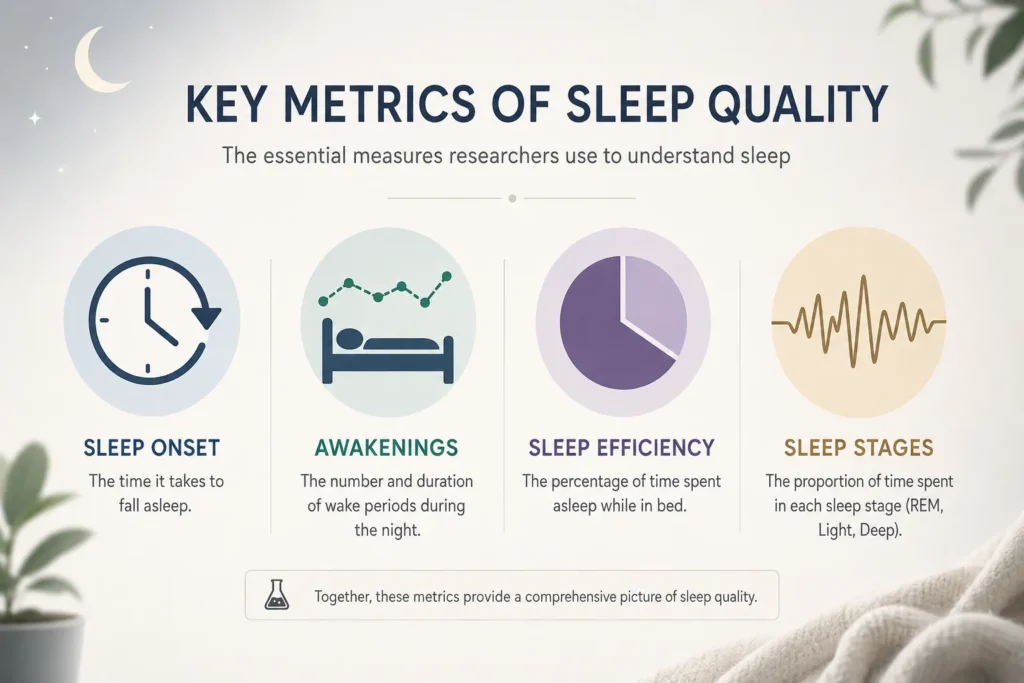
In sleep science, “sleep quality” is more than just how many hours you sleep; it is a multi-faceted concept that describes how well you sleep. While you might describe a “good” night’s sleep based on feeling rested, researchers use specific, measurable metrics to assess it objectively. Understanding these terms can help you make sense of headlines and studies about sleep science.
Different studies may focus on different metrics, which is one reason their conclusions can vary. Some rely on questionnaires where people self-report their experiences, while others use devices to gather objective data. Most researchers agree that high-quality sleep is consolidated, restorative, and leaves you feeling alert the next day.
| Measure | What It Is | How It’s Measured |
|---|---|---|
| Sleep Onset Latency (SOL) | The time it takes to fall asleep after getting into bed. | Actigraphy, Polysomnography (PSG), Questionnaires |
| Wake After Sleep Onset (WASO) | Total time spent awake after you’ve initially fallen asleep. | Actigraphy, PSG, Questionnaires |
| Sleep Efficiency | The percentage of time in bed that you are actually asleep. | Actigraphy, PSG, Sleep Trackers |
| Total Sleep Time (TST) | The total duration of sleep during a sleep period. | Actigraphy, PSG, Sleep Diaries |
| Perceived Sleep Quality | A person’s subjective rating of how well they slept. | Questionnaires (e.g., PSQI) |
What Research Says About Night Shift Sleep Quality
Research consistently finds an association between night shift work and challenges with sleep quality. Because working at night forces a schedule that is out of sync with the body’s internal clock, or circadian rhythm, many shift workers struggle to get sufficient, restorative rest. This can lead to feeling tired even after a full “night’s” sleep in the daytime.
A 2024 cross-sectional study focused on 711 night-shift nurses provides a stark example. The researchers reported that an overwhelming 90.1% of the participants experienced poor sleep quality [1]. Other long-term studies have found that a higher load of night shifts is directly associated with shortened sleep duration and clinical sleep deprivation over time [7]. This body of evidence highlights why so many night shift workers feel tired all the time.
It’s important to distinguish between two types of findings:
- Self-reported data comes from surveys and questionnaires, where people describe their own sleep experiences. This is valuable for understanding perceived quality and personal impact.
- Objectively measured data comes from devices like actigraphy watches or lab-based sleep studies (polysomnography) that track movement, heart rate, and brain waves. This provides a more direct measurement of sleep patterns.
Both types of data generally point in the same direction: night shift work presents a significant challenge to achieving high-quality sleep.
Night Shift Sleep Quality: What the Research Finds
When researchers directly compare sleep patterns, the data reveals clear differences between night and day workers. A 2024 meta-analysis, which combined the results of multiple studies using objective actigraphy data, found significant differences in several key sleep quality metrics [2].
Compared to day workers, night shift workers were found to have:
- Longer Sleep Onset Latency: It took them more time to fall asleep after a shift.
- More Wake Time After Sleep Onset (WASO): They spent more time awake during their main sleep period.
Interestingly, this particular meta-analysis did not find a significant difference in overall sleep efficiency (the percentage of time in bed spent asleep) between the groups [2]. This may suggest that while night workers have more fragmented sleep, the total proportion of sleep within their time in bed can sometimes be similar. However, other individual studies have found lower sleep efficiency in night workers, so the evidence varies.
These findings do not mean every night shift worker has poor sleep. Individual factors like age, genetics, lifestyle, and home sleep environment play a huge role. Rather, the research shows that on a population level, working nights creates a higher risk for sleep disruption.
What Sleep Trackers and Actigraphy Studies Add
The rise of consumer wearables and research-grade actigraphy devices has given sleep scientists a powerful window into real-world sleep patterns. Unlike a one-night lab study, these devices can collect data for weeks or months, showing how sleep quality changes with different shift schedules.
Actigraphy studies have been crucial in confirming what shift workers have long known from experience. For example, the 2024 meta-analysis confirmed that night workers get less total sleep and have more disrupted sleep compared to their day-working peers [2]. These devices provide the objective data behind the subjective feelings of fatigue.
This technology is also paving the way for new approaches to fatigue management. A 2024 study demonstrated that machine learning models could use data from consumer wearables, specifically heart-rate variability (HRV), to predict a person’s sleep efficiency with high accuracy [8]. In the future, a tool like a Sleep Analyzer could potentially offer predictive insights to help shift workers plan their recovery days more effectively.
However, it’s important to recognize the limitations:
- Accuracy: While good at estimating sleep and wake times, most consumer wearables are less accurate at identifying specific sleep stages (like deep or REM sleep).
- Context is Missing: A tracker knows you were awake, but it doesn’t know why. Was it noise, stress, or a child waking you up? This context is crucial for finding solutions.
Why Study Results Can Differ
If you follow sleep research, you might notice that different studies sometimes report conflicting results. One study might find a strong link between night shifts and poor sleep efficiency, while another finds no significant difference. This doesn’t necessarily mean one is wrong; it often reflects differences in how the research was conducted.
Several key factors can influence a study’s outcome:
- Shift Schedules: A study on nurses working three consecutive 12-hour night shifts may yield very different results than one on factory workers with a slowly rotating 8-hour shift pattern. Research suggests limiting shifts to 9 hours or less and for no more than 3 consecutive nights is beneficial [3].
- Permanent vs. Rotating Shifts: Some research has explored whether permanent night workers eventually adapt. However, a 2024 study found that even among permanent night workers, sleep quality and duration decreased after night shifts, suggesting full adaptation is elusive [7].
- Measurement Methods: A study using self-reported questionnaires might capture the feeling of poor sleep, while an actigraphy study measures the objective fragmentation. Both are valid but measure different things.
- Sample Population: Findings from a study on young, healthy first responders may not apply to older workers with pre-existing health conditions.
Because of these variations, it’s important to look at the overall body of evidence from many studies rather than focusing on a single result. The consistent theme across most research is that night work disrupts the body’s natural sleep-wake cycle.
What the Data Can, and Cannot, Tell Us
Scientific research provides powerful insights into the challenges of night shift sleep quality, but it’s essential to understand its limitations. Research findings are based on population averages and probabilities, not individual certainties.
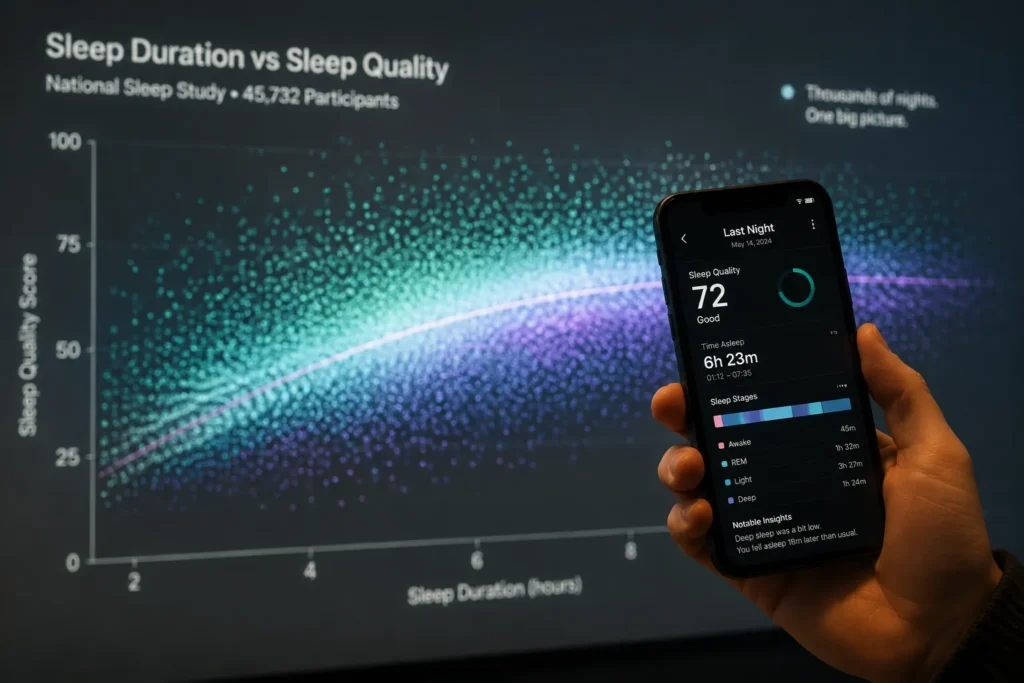
Association is not Causation
This is one of the most important concepts in understanding health research. A study might find that night shift workers have a higher association with a certain health outcome. This means the two things occur together more often in the data. It does not prove that working the night shift caused the outcome. Other factors (like diet, exercise, or stress levels) could be involved.
Statistics are not a Diagnosis
If a study reports that 90% of night-shift nurses have poor sleep quality, it doesn’t automatically mean you are in that 90% [1]. It simply describes the overall pattern within that specific group. Your personal experience is unique. Research statistics should never be used to self-diagnose a condition. They are a tool for understanding risks and tendencies across a large group of people.
When looking at sleep research, always consider:
- Who was studied? (e.g., nurses, factory workers, police officers)
- How was sleep measured? (e.g., survey, wearable device)
- How long was the study? (e.g., one week, two years)
This context helps you understand how the findings might apply, or not apply, to your own situation.
Key Takeaways From the Research
After reviewing dozens of studies on night shift sleep quality, a few practical, evidence-informed themes emerge. This information is for educational purposes and should not be considered a substitute for professional medical advice.
- Prioritize a Dark, Quiet, Cool Sleep Space: This is the single most important and well-supported strategy. Light is the most powerful signal to your brain’s internal clock. Using tools like blackout curtains is essential for quality daytime sleep.
- Consider Your Schedule: The evidence is growing that the type of shift schedule matters. Research suggests that limiting the number of consecutive night shifts to three or fewer can be beneficial for sleep [3]. If you have any influence over your schedule, this is a key area to focus on.
- Strategic Use of Light: Just as you should block light during daytime sleep, using light strategically when you need to be awake can help. A systematic review found light therapy had the strongest positive effect on sleep quality for rotating shift workers [5]. A recent trial also showed that specialized circadian lighting in the workplace can increase sleep duration by nearly an hour [4].
- Be Cautious with Sleep Aids: While it might be tempting to reach for a pill, expert reviews have indicated that sedative-hypnotics do not consistently improve sleep quality or duration after a night shift and do not help reset the body’s circadian rhythm [6].
Ultimately, the research provides a map of the challenges and potential solutions. For a more detailed look at practical tips, see our guide on how to sleep better after a night shift.
Conclusion
The body of scientific evidence is clear: maintaining high night shift sleep quality is a significant challenge. The fundamental conflict between a nocturnal work schedule and our innate circadian biology creates measurable disruptions in sleep patterns, from taking longer to fall asleep to experiencing more awakenings. Research consistently shows that, as a group, night shift workers sleep less and have more fragmented sleep than their day-shift counterparts.
However, the research also illuminates a path forward. It highlights the critical importance of managing your environment, particularly your exposure to light. It points to the potential benefits of scheduling strategies, like limiting consecutive night shifts, and emerging technologies like circadian-informed lighting.
Understanding what the research shows is the first step toward developing effective, personalized strategies. By focusing on evidence-informed habits and routines, shift workers can take practical steps to improve their rest and recovery. If you have persistent concerns about your sleep or fatigue, it is always best to consult with a qualified healthcare professional who can provide guidance based on your individual circumstances.
Overall, night shift sleep quality varies across workers and schedules, and research findings depend on how sleep is measured and which populations are studied.