
Last updated: August 10, 2026
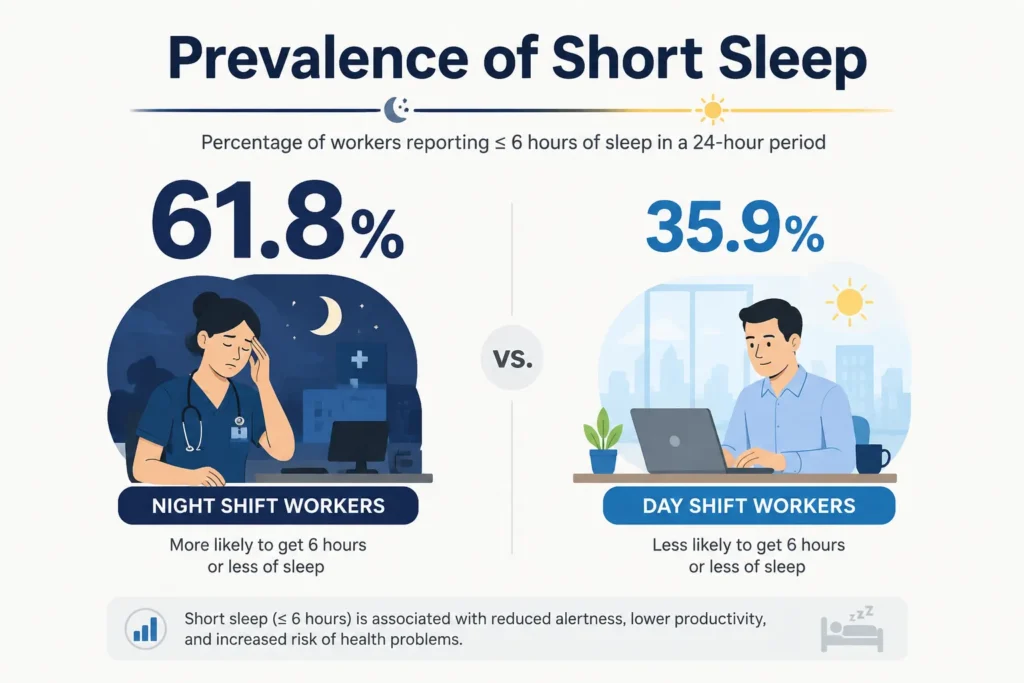
Sleep statistics for night shift workers provide a useful picture of how sleep duration and timing compare with daytime schedules. Workforce data consistently shows that night-shift and rotating-shift workers get less sleep than their daytime counterparts. On average, night-shift workers sleep 1.5 to 2 hours less per 24-hour period, and CDC/NIOSH data reveals that nearly 62% of night-shift workers experience short sleep duration, compared to about 36% of day-shift workers [1, 2].
Key Takeaways
- Significant Sleep Reduction: Data from multiple sources indicates that working night shifts is strongly associated with getting less sleep. Night-shift workers average 5 to 6 hours of sleep, a reduction of 1.5 to 2 hours compared to typical day workers [2].
- High Prevalence of Short Sleep: According to the CDC, 61.8% of people working the night shift get less than the recommended seven hours of sleep per day. This is substantially higher than the 35.9% prevalence among daytime workers [1].
- Rotating Shifts Are Challenging: Some of the most significant sleep debt is seen in those on rotating schedules. One study found workers on rotating 12-hour night shifts got the least amount of sleep, averaging just 5 hours per day [3].
- Older Workers Are Affected: The sleep gap persists across age groups. Among employed adults aged 55 and older, 44.0% of night-shift workers reported sleeping 6 hours or less, compared to 28.8% of day-shift workers [4].
- Circadian Misalignment is Key: The fundamental challenge of shift work is the conflict between the work schedule and the body’s internal 24-hour clock, or circadian rhythm. This misalignment is a primary factor contributing to sleep difficulties [8].
- Data Shows Averages, Not Destiny: While the statistics are clear on a population level, they represent averages. Individual sleep needs and responses to shift work can vary significantly.
What Research Says About Shift Work and Sleep
Research consistently shows a strong association between shift work, particularly night and rotating shifts, and challenges with sleep. The core issue is a conflict with the body’s natural 24-hour cycle, known as the circadian rhythm [8]. This internal clock regulates periods of sleepiness and wakefulness. When a work schedule requires someone to be awake at night and sleep during the day, it forces them to operate against these powerful biological signals.
This conflict, often called circadian misalignment, is linked to several key findings in studies on shift work and sleep:
- Shorter Sleep Duration: People on night and rotating shifts tend to sleep less overall than those on standard day schedules [1, 2].
- Poorer Sleep Quality: Sleep during the daytime is often lighter, more fragmented, and less restorative than nighttime sleep due to environmental factors like light and noise, as well as the body’s internal drive for wakefulness.
- Increased Sleepiness: The combination of sleep loss and circadian disruption can lead to significant sleepiness and fatigue, both during shifts and on days off.
It’s important to understand that these findings show a strong association, but they don’t mean every single shift worker will experience the same outcome. Many factors, including genetics, age, lifestyle, and specific work schedule, play a role.
Sleep Statistics for Night Shift Workers: How Much Sleep Do They Get?
The data shows a clear and significant gap in sleep duration for those working non-traditional hours. While sleep researchers and health organizations generally recommend 7 to 9 hours of sleep for most adults, many shift workers consistently fall short of this benchmark.
The CDC defines “short sleep duration” as getting less than 7 hours of sleep in a 24-hour period. According to their data, nearly two-thirds of night-shift workers (61.8%) fall into this category [1]. Other research reinforces this, finding that night-shift workers typically get only 5 to 6 hours of sleep, which is about 1.5 to 2 hours less than their non-shift-working peers [2]. For context, the CDC’s 2024 data brief reported that about 30.5% of the entire U.S. adult population gets less than 7 hours of sleep, highlighting how much more common short sleep is within the night-shift community [5].
Shift Work & Sleep: Key Data
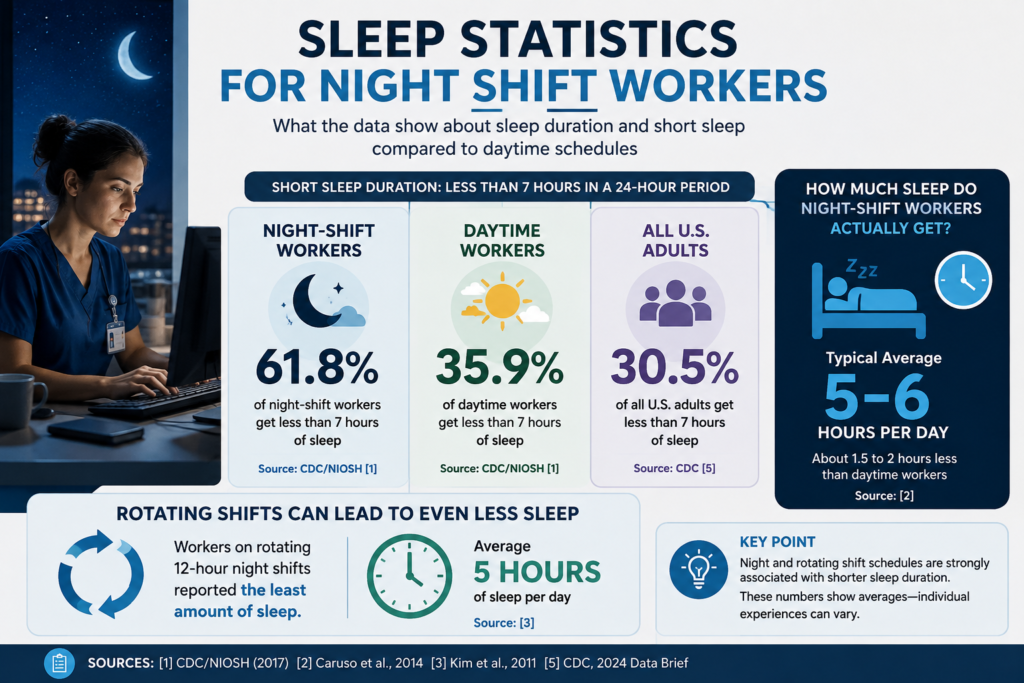
| Worker Group | Prevalence of Short Sleep (<7 hrs) |
|---|---|
| All U.S. Adults (Baseline) | 30.5% Source: CDC [5] |
| Daytime Workers | 35.9% Source: CDC/NIOSH [1] |
| Night-Shift Workers | 61.8% Source: CDC/NIOSH [1] |
| Rotating 12-Hr Night Shifts | Leads to severe sleep debt (avg. 5 hrs sleep) Source: NCBI [3] |
Night Shift vs. Day Shift: What the Numbers Show
These sleep statistics for night shift workers provide a useful comparison with daytime workers, but they should be understood as population-level findings rather than predictions about every individual.
As noted, the most striking statistic from the CDC is the prevalence of short sleep duration:
- Night-Shift Workers: 61.8% get less than 7 hours of sleep.
- Day-Shift Workers: 35.9% get less than 7 hours of sleep [1].
This means a night-shift worker is nearly twice as likely to experience short sleep as their daytime counterpart. This disparity holds even when looking at specific age demographics. For example, in a CDC study of employed adults aged 55 and older, 44.0% of those on night shifts slept 6 hours or less, compared to just 28.8% of those on day shifts [4].
While these numbers are compelling, they represent population averages. Not every night worker struggles with sleep, and some day workers do. However, the data clearly indicates that working at night creates a much higher statistical likelihood of obtaining insufficient sleep. For more practical information, see our guide on how to sleep better after a night shift.
What About Rotating-Shift Workers?
Rotating-shift workers face a unique and often more difficult challenge. Unlike permanent night workers who may adapt to a consistent (though inverted) schedule, rotating-shift workers must constantly readjust their body clocks. This perpetual state of flux can be particularly disruptive to sleep patterns.
Research highlights the intensity of this challenge. A study focusing on different work rosters found that employees on rotational 12-hour night shifts experienced the shortest workday sleep, averaging a mere 5 hours per day [3]. This led to what the researchers termed “severe sleep debt,” even when workers tried to catch up on their days off.
A 2025 study in Frontiers in Public Health reinforced these findings, concluding that both permanent night schedules and rotating schedules were associated with the highest odds of severe sleep disturbance and circadian misalignment when compared to standard day shifts [6]. The constant shifting of sleep and wake times prevents the body from ever fully synchronizing to a stable routine.
Why Timing Matters: Sleep, Circadian Rhythms, and Shift Schedules
The reason shift work and sleep are so intertwined comes down to biology. Every cell in your body runs on an internal 24-hour clock, known as the circadian rhythm. This “master clock,” located in the brain, coordinates countless bodily functions, from hormone release and digestion to body temperature and, most importantly, the sleep-wake cycle.
Your circadian rhythm is primarily synchronized by light exposure. When light enters your eyes, it signals to your brain that it’s daytime and time to be alert. As darkness falls, your brain gets the signal to produce melatonin, a hormone that promotes sleep.
Shift work directly conflicts with this system.
- Night shift requires you to be awake and alert when your body is biologically programmed for sleep.
- Daytime sleep requires you to sleep when your body is programmed for wakefulness, and you’re exposed to daylight.
This mismatch, or circadian misalignment, is why daytime sleep is often shorter and less refreshing. You are essentially fighting against a powerful, deeply ingrained biological drive for wakefulness. As noted by Harvard Health, this misalignment is considered the primary mechanism through which shift work can impact long-term health [8]. Understanding this biological conflict is the first step in developing practical strategies to manage it, which is a core topic in sleep science.
What Recent Research Is Adding to the Picture

The body of research on shift work and sleep continues to grow, with newer studies confirming and expanding upon established findings. Recent data often looks at the real-world context of modern work and its impact on sleep.
For instance, a March 2025 report highlighted how the challenges of late shifts are now compounded by other aspects of modern life, such as increased screen time, sedentary work, and the “always-on” culture of hyperconnectivity [7]. These factors can make it even harder for workers to disconnect and achieve restorative sleep, even when they have the opportunity.
The 2025 Frontiers in Public Health study further solidified the connection between non-daytime schedules and sleep problems. It specifically found that working always-night or rotating shifts carried the highest odds of severe sleep disturbance [6]. This type of recent, large-scale research helps confirm that the sleep challenges associated with shift work are a persistent and widespread issue in today’s workforce.
What the Data Do NOT Tell Us
While the statistics are powerful, it is crucial to understand their limitations. Data provides a big-picture view, but it cannot predict an individual’s specific experience.
- Correlation vs. Causation: Most studies show a strong association between shift work and sleep problems. While the biological link through circadian disruption is well-established, these studies don’t prove that shift work causes a specific outcome in every single person. Other factors like lifestyle, health status, and stress also play significant roles.
- Individual Differences: People respond to shift work differently. Some individuals seem to adapt more easily to night work, while others struggle immensely. This can be due to genetic predispositions (being a “night owl” vs. a “morning lark”), age, and other personal factors. The data reflects an average, not a rule.
- Self-Reported Data: Much of the research relies on people self-reporting how much they sleep. While useful, this can sometimes be inaccurate. People may overestimate or underestimate their sleep, and it doesn’t always capture the nuances of sleep quality.
- Variety in Schedules: The term “shift work” covers a vast range of schedules, 8-hour vs. 12-hour shifts, fixed vs. rotating shifts, and slow vs. fast rotations. The data often groups these together, but the impact of a stable, permanent night schedule may be very different from that of a rapidly rotating one.
What Shift Workers Can Take Away From the Research
The data isn’t meant to be discouraging but rather empowering. Understanding the research-backed challenges of shift work and sleep can help you develop realistic and effective strategies. The key is to focus on what you can control. If you often feel tired, you’re not alone; our article on why night shift workers feel tired all the time explores this common experience.
Here are some practical takeaways from the data:
- Acknowledge the Challenge: The research confirms that sleeping well as a shift worker is genuinely difficult. It’s not a personal failing but a biological reality. This understanding can help you prioritize sleep without self-criticism.
- Protect Your Sleep Time: Since your sleep is more likely to be shorter, protecting the sleep you can get is critical. This means creating a sleep-conducive environment. Investing in tools like the best blackout curtains for shift workers can make a significant difference in blocking daytime light.
- Prioritize Consistency When Possible: If you work a permanent night schedule, try to maintain that schedule even on your days off. If you’re on a rotating schedule, try to rotate forward (from day to evening to night) if you have any control, as this is generally easier on the body clock.
- Manage Your Light Exposure: Use light to your advantage. Get bright light exposure when you need to be alert (like during your shift) and make your environment as dark as possible when you need to sleep.
- Listen to Your Body: Pay attention to your own levels of fatigue and sleepiness. The data provides averages, but your personal experience is your most important guide. Understanding concepts like what sleep drive is can help you better interpret your body’s signals.
Conclusion
The data paints a clear picture: shift work, especially night and rotating schedules, presents a significant challenge to healthy sleep. Research consistently shows that shift workers, on average, get less sleep and face a higher risk of sleep disturbance due to the fundamental conflict with the body’s internal clock.
However, these statistics are not a sentence to a lifetime of fatigue. By understanding the “why” behind these challenges, the science of circadian rhythms, shift workers can adopt practical, evidence-informed strategies to improve their sleep and manage their energy. Protecting your sleep opportunity, creating a dark and quiet sleep environment, and maintaining as much consistency as your schedule allows are powerful first steps.
This information is for educational purposes. If you have significant concerns about your sleep, fatigue, or overall health, it is always best to consult with a qualified healthcare professional who can provide guidance based on your individual circumstances.
Overall, the available sleep statistics for night shift workers point to meaningful differences in sleep duration and timing, while also showing why individual schedules and circumstances matter.