

Last updated: August 2, 2026
Why do night shift workers feel tired all the time? Night shift workers often struggle with fatigue because their work schedule forces them to be awake when their internal body clock, or circadian rhythm, is programmed for sleep.
Key Takeaways
- Circadian Misalignment: The main reason for shift work fatigue is the conflict between your work hours and your body’s natural 24-hour sleep-wake cycle.
- Poor Sleep Quality: Sleeping during the day is often lighter, shorter, and more fragmented than sleeping at night due to light, noise, and a misaligned body clock.
- Accumulated Sleep Debt: Consistently poor sleep creates a “sleep debt” that builds over time, leading to chronic exhaustion and difficulty concentrating.
- Hormonal Disruption: Working at night disrupts the natural release of hormones like melatonin (which promotes sleep) and cortisol (which promotes alertness).
- Rotating Shifts Worsen Fatigue: Constantly changing schedules prevent the body clock from ever fully adjusting, making fatigue more severe.
- Environmental Challenges: Daylight, household noise, and social obligations make it difficult to get uninterrupted, high-quality rest during the day.
- Fatigue is Manageable: While challenging, shift work fatigue can be significantly reduced with practical strategies for sleep timing, light management, and recovery.
Finishing a long night shift only to feel exhausted after a full day’s sleep is a frustratingly common experience for millions of workers. You might get seven or eight hours in bed, but you still wake up feeling groggy, irritable, and never fully rested. This isn’t a personal failure or a lack of discipline; it’s a biological reality. Understanding why do night shift workers feel tired all the time is the first step toward reclaiming your energy and improving your health.
The core of the problem lies in a conflict between your work schedule and the ancient, hard-wired programming of the human body.
The Main Reason Night Shift Workers Feel Tired: Your Body Clock Is Misaligned
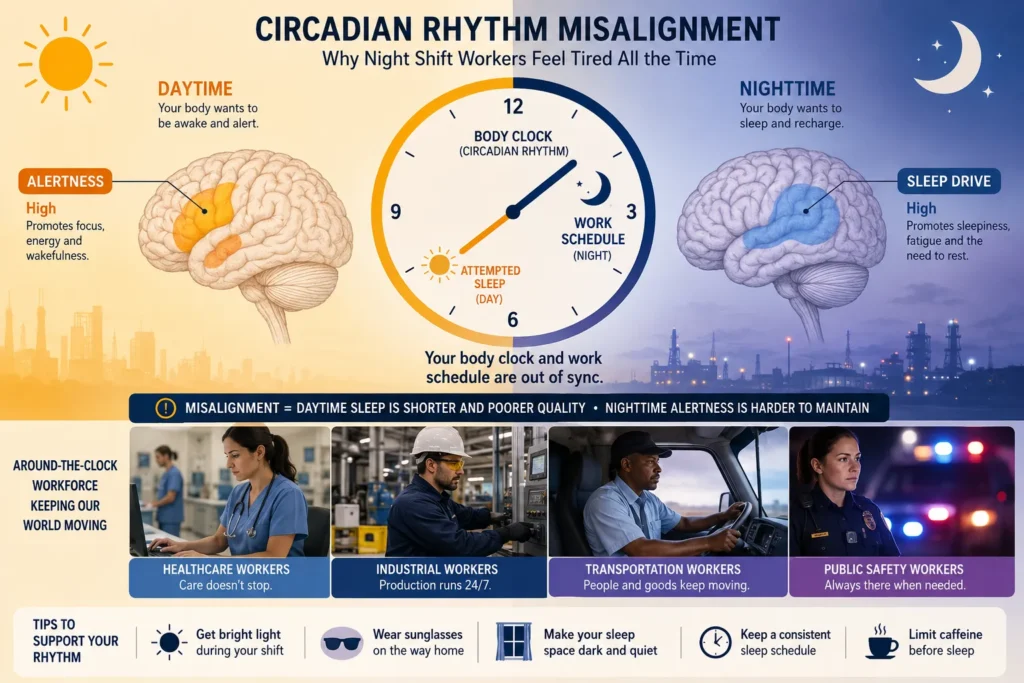
Understanding why do night shift workers feel tired all the time starts with understanding how the body’s internal 24-hour clock works. The primary reason you feel tired is that your work schedule is fighting your circadian rhythm. This internal clock is designed to align your body’s functions with the natural cycle of day and night, making you feel sleepy in the evening and alert during the day.
Your brain contains a “master clock” called the suprachiasmatic nucleus (SCN). The SCN takes its primary cue from light exposure detected by your eyes [1]. When it gets dark, the SCN signals the brain to release melatonin, a hormone that makes you feel sleepy. When you are exposed to light in the morning, melatonin production stops, and your body releases hormones like cortisol to promote wakefulness and energy.
Working at night creates a major conflict. Your schedule demands you be alert precisely when your brain is releasing sleep hormones and lowering your core body temperature to prepare for rest. Conversely, when your shift ends in the morning, you are trying to sleep just as the sun is rising and your body clock is starting its “wake up” program. You are essentially in a constant state of jet lag.
How Night Shift Work Disrupts Sleep Quality
This biological conflict explains why do night shift workers feel tired all the time, even when they spend enough hours in bed.Sleeping during the day is not the same as sleeping at night, even if you are in bed for the same number of hours. The sleep you get is often less restorative because your body clock is actively working against it.
Shift workers often experience:
- Shorter Sleep Duration: Many night shift workers get one to four hours less sleep per day than their day-shift counterparts.
- Fragmented Sleep: Sleep during the day is lighter and more easily disturbed by noise, light, and family activities. This prevents you from cycling through the deeper, more restorative stages of sleep.
- Environmental Disruption: Even with precautions, it’s difficult to create a sleep environment as dark and quiet as a bedroom at night. High-quality tools like the best blackout curtains for shift workers can make a significant difference in blocking out daylight.
This leads to a lower quality of rest, which is a key reason why do night shift workers feel tired all the time.
Sleep Debt and Fatigue Build Up Over Time
Consistently failing to get the restorative sleep your body needs creates a condition known as sleep debt. Think of it like a financial debt; each night of poor sleep adds to the balance, and it must be “paid back” with adequate recovery.
When sleep debt accumulates, you begin to experience the effects of chronic fatigue. Your body doesn’t have enough time to complete its essential repair and recovery processes that happen during deep sleep. This cumulative fatigue affects nearly every aspect of your life:
- Cognitive Function: Difficulty concentrating, poor memory, and slower reaction times.
- Mood: Increased irritability, anxiety, and risk of mood swings.
- Physical Health: A weakened immune system and long-term health risks.
Understanding what sleep drive is can help you better manage your body’s natural need for rest and prevent this debt from growing.
Why 12-Hour and Rotating Shifts Can Increase Fatigue
Longer shifts and unpredictable schedules add another layer of difficulty to managing fatigue. Both of these common scheduling practices can make it even harder for your body to adapt.
The Challenge of 12-Hour Shifts
Working 12-hour shifts, especially in physically or mentally demanding jobs, significantly increases the time you spend awake while reducing the time available for sleep and recovery. This is one of the reasons why do night shift workers feel tired all the time, as longer shifts can accelerate the buildup of sleep debt over several consecutive workdays and leave your body with less time to recover.
Why Rotating Shifts Are So Draining
Rotating shifts, where you might work nights for a week, then switch to days or evenings, are particularly disruptive. This type of schedule helps explain why do night shift workers feel tired all the time, because the body never gets a chance to establish a stable sleep pattern. Your body’s circadian rhythm never gets a chance to adjust to a consistent pattern [2]. Just as it starts to adapt to a night schedule, the schedule changes, and the adaptation process has to start all over again.
Common Reasons Night Shift Workers Feel Exhausted
Beyond the core biological conflict, several common habits and environmental factors contribute to the persistent feeling of exhaustion among shift workers.
- Inconsistent Routines: Switching between a night-shift schedule on workdays and a day-oriented schedule on days off confuses your body clock even more.
- Poor Sleep Environment: Trying to sleep in a room that is too bright, noisy, or warm makes restorative sleep nearly impossible.
- Mistimed Caffeine: Using coffee or energy drinks late in your shift can keep you awake when you get home and try to sleep, further disrupting your rest.
- Lack of Recovery Days: Not scheduling enough downtime between long stretches of shifts prevents your body from catching up on lost sleep.
- Poor Sleep Timing: Going to bed immediately after a shift might not work for everyone. Some people find they get better sleep by winding down for an hour or two first.
How Night Shift Workers Can Reduce Fatigue

While you can’t change your body’s biology, you can adopt science-backed strategies to work with it more effectively. A proactive approach to sleep and recovery is essential for managing shift work fatigue.
Here are practical fatigue solutions you can implement today:
Before addressing solutions, it is important to understand why do night shift workers feel tired all the time and which factors have the biggest impact on recovery.
- Create a Consistent Sleep Schedule: As much as possible, go to bed and wake up at the same time every day, even on your days off. This helps stabilize your body clock. For more tips, see this science-backed guide on how to sleep better after a night shift.
- Master Your Light Exposure: Light is the most powerful signal for your circadian rhythm. Wear sunglasses on your drive home from a night shift to block morning light. Conversely, use bright light exposure at the beginning of your shift to signal to your brain that it’s time to be alert.
- Optimize Your Sleep Environment: Turn your bedroom into a cave. Use blackout curtains, wear an eye mask, use earplugs or a white noise machine, and keep the temperature cool. Your goal is to make it as dark, quiet, and cool as possible.
- Use Strategic Naps: A short nap before your shift or a planned nap during a break (if permitted) can significantly boost alertness. Learn more about the optimal nap times for a night shift.
- Time Your Caffeine Correctly: Enjoy your coffee or tea at the beginning of your shift, but avoid caffeine within 6-8 hours of your planned bedtime.
- Prioritize Recovery: Use your days off for true rest and sleep recovery. Avoid scheduling too many errands or activities that cut into your sleep time. Getting good night shift sleep is a skill that can be learned.
Caffeine Cutoff Calculator
How ShiftNap Helps Workers Manage Fatigue Better
At ShiftNap, our mission is to provide shift workers with the knowledge and tools they need to manage fatigue and improve their sleep. We believe that with practical, science-backed strategies, you can take control of your recovery and well-being.
We focus on translating complex sleep science into actionable advice for people working non-traditional hours. From nurses and first responders to truck drivers and factory workers, we are here to support you with reliable information. Explore our blog to find more resources tailored to the challenges of shift work.
Conclusion
Understanding why do night shift workers feel tired all the time helps explain that persistent fatigue is not a sign of weakness but a natural response to working against the body’s internal clock. The constant battle against your internal body clock, combined with lower-quality daytime sleep, creates a cycle of fatigue that can feel impossible to break.
If you’ve been wondering why do night shift workers feel tired all the time, the answer lies in the way shift work disrupts your body’s natural sleep-wake cycle. However, you are not powerless. By understanding the science behind your fatigue, you can make strategic changes to your routine…
Frequently Asked Questions (FAQ)
How long does it take to get used to the night shift?
Why do night shift workers feel tired all the time, even after months of working nights? True adaptation is difficult because your body’s circadian rhythm is strongly tied to natural light. While some people adjust better than others over weeks or months, why do night shift workers feel tired all the time often comes down to the fact that their internal body clock never fully adapts to a permanent night schedule. As a result, most shift workers need to actively manage their sleep, recovery, and fatigue.
Is it better to sleep right after a night shift or wait?
This varies by individual. Some people find they sleep best immediately after their shift, while others benefit from a 1-2 hour wind-down period. Experiment to see what works best for you. The most important factor is maintaining a consistent schedule once you find it.
Should I take melatonin for night shift work?
Melatonin can help some people fall asleep, but it’s not a magic bullet for shift work fatigue. It’s best to consult a healthcare professional before starting any new supplement to discuss appropriate timing and dosage.
Can you ever fully adapt to working nights?
For most people, the answer is no. The strong cues from daylight mean the body clock always feels a pull to be awake during the day. This is why proactive fatigue management strategies are so crucial for long-term shift workers.
What are the signs of Shift Work Sleep Disorder?
Shift Work Sleep Disorder (SWSD) is a diagnosed circadian rhythm sleep disorder. Symptoms include excessive sleepiness during work hours, insomnia when trying to sleep, lack of refreshing sleep, and difficulty concentrating [1]. If you experience these severely, it’s important to speak with a doctor.
How can I explain my sleep needs to my family?
Explain to your family that sleeping during the day is a requirement for your job and health, just like their nighttime sleep is for them. Emphasize that you need a dark, quiet environment to get restorative rest and ask for their help in minimizing noise and light during your sleep hours.
Why do night shift workers feel tired all the time?
Why do night shift workers feel tired all the time? Their work schedule conflicts with their circadian rhythm, making it harder to get deep, restorative sleep. Over time, this leads to sleep debt, fatigue, and reduced alertness, even if they spend enough hours in bed.